


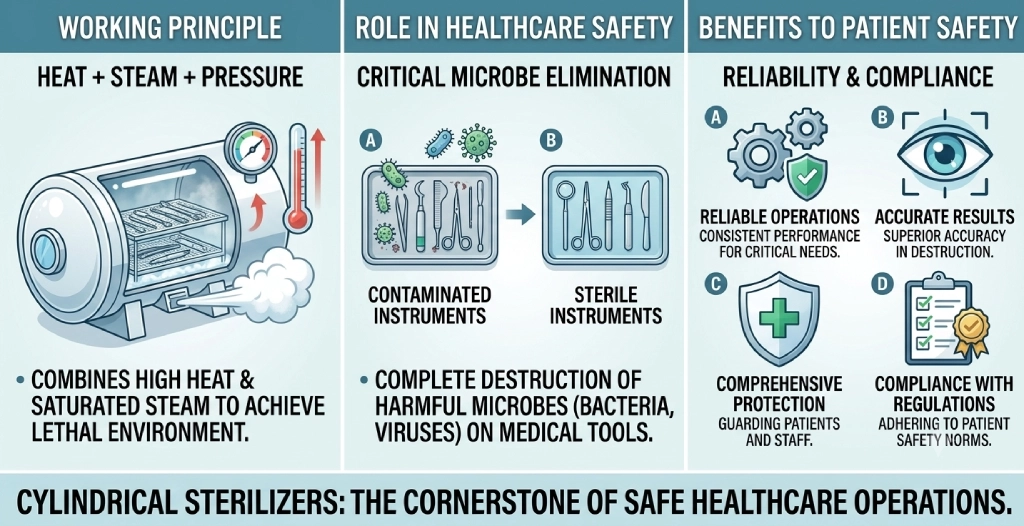
Working Principle of a Cylindrical Sterilizer and Its Role in Safe Healthcare Operations
Sterilization is a crucial process in healthcare operations where harmful microbes, bacteria, viruses, and fungi are completely eliminated from medical instruments. While sterilization is an important part of multiple industries, it is highly emphasized in the healthcare sector as it concerns people’s health and welfare. And in order to achieve optimal results, a specialized cylindrical sterilizer is used by healthcare organizations, which allows for reliable operations, accurate results, comprehensive protection, and compliance with patient safety regulations.
Cylindrical sterilizers, commonly referred to as autoclaves, are complex pieces of engineering made that use advanced technology to kill harmful microbes with superior accuracy. But how exactly do they achieve this accuracy? This blog will help you understand this by explaining to you how they actually work and kill harmful microscopic dangers.
Cylindrical Sterilizer – A Brief Description
Sterilizers are extensively used in industrial and commercial applications with high contamination risks. They mainly use moisture and dry heat to remove even the smallest microbial life from equipment, clothes, and liquids. Due to the involvement of high-pressure steam, the geometry of the sterilizers plays a key role in ensuring safe operations. A cylindrical sterilizer, because of its efficient design, equally distributes the pressures on the sterilizer walls to prevent dangerous stress/pressure accumulation.
The Working Principle of a Cylindrical Sterilizer
High-temperature steam produced in the cylindrical sterilizer can penetrate deeply into the medical tools, equipment, and liquids, where it kills every microorganism with superior efficiency. However, as easy as it looks, the process is highly sophisticated and requires advanced engineering support. This is because the accuracy expected by the cylindrical sterilizer is extremely high, with a Sterility Assurance Level (SAL) of 10⁻⁶. What this means is that the sterilizer must be accurate enough that there is only a one in a million chance of survival for any microorganism. Thus, it has a sophisticated and systematic working principle, which is explained in the points below:
Materials are Loaded into the Sterilizer
Medical instruments, equipment, and other sterilization-compatible items are placed inside the cylindrical sterilizer chamber. Depending on the scale of the sterilizer, you can add multiple instruments at the same time.
For example, the sterilizer size range by Sambion goes from 75L to 5000L, allowing you more flexibility in making the right choice.
Air Removal
Air is removed from the chamber to ensure proper sterilization, as trapped air forms pockets that hinder the sterilization process. Typically, a vacuum system is used to ensure effective steam penetration.
Steam Injection
This is the most important part of the sterilization process, where high-temperature saturated steam is introduced into the chamber to sterilize the loaded materials. The temperature of the steam must be high enough to achieve optimal results.
Temperature and Pressure Control
The sterilizer, using an advanced PLC control system, maintains the required temperature and pressure for the required time to eliminate microorganisms, including bacteria, viruses, and spores.
Sterilization Cycle
The sterilization process is performed in structured cycles to ensure better results. Thus, the items remain exposed to steam under controlled conditions for a specified duration to achieve the required level of sterilization.
Steam Exhaust and Drying
After sterilization, steam is released safely, and the materials are dried when the cycle requires it. This critical final step of the sterilization process removes the residual moisture, all while protecting the machine from rust and corrosion.
Unloading and Inspection
Once the chamber reaches safe opening conditions, the sterilized materials are removed and checked before further use or storage.
Critical Role of Cylindrical Sterilizers in Patient Safety
- Elimination of Harmful Pathogens: Eliminates harmful microorganisms from medical instruments through controlled sterilization cycles and makes them safe for reuse.
- Preventing Cross-Contamination: Significantly reduces the risk of transferring infectious agents, bacteria, fungi, and other harmful microorganisms between patients through contaminated medical equipment.
- Compliance with Safety Regulations: Supports healthcare facilities in following established sterilization protocols and infection-control standards, which is extremely important for both patient safety and compliance with legal regulations.
Get Cylindrical Sterilizers with Customizable Add-ons for Higher Performance
Sambion is a certified CSSD equipment supplier with over 20 years of experience and a diverse range of products that are certified by both national and international standards. Each product is designed with advanced engineering, professional guidance, and in accordance with all compliance requirements. On top of that, Sambion delivers solutions including CSSD furniture and accessories across the globe to help international healthcare organizations conduct quality-compliant and safe healthcare operations.
Why You Should Partner with Sambion
- Product range accepted by WHO, UNIDO, UNICEF, and UNOPS
- Equipment range that complies with ISO, CE, FDA, GMP, and multiple other international standards.
- Diverse product catalog that covers solutions for all prominent CSSD requirements
- A Global presence with a robust logistics network
- Comprehensive after-delivery support by the best engineering minds.
- Choose between multiple add-ons, including Automatic Boiler Water Feeding / Emptying System, Steam Door Sealing System (instead of pneumatic), Online Circular Data Plotter (instead of online printer), and Sterilized Air Injection for Vacuum Breaking Cycle.
Enhance the safety and energy efficiency of your CSSD operation with Sambion and start with a comprehensive consultation with our experts.
Concluding Note
Cylindrical sterilizers play an essential role in modern healthcare operations to ensure patient safety. Their role is to eliminate harmful microorganisms from reusable medical instruments and equipment to prevent disease spread and cross-contamination. Their efficient chamber design, controlled steam supply, and precise temperature and pressure regulation support reliable sterilization. From proper loading and air removal to steam exposure and drying, every stage contributes to maintaining instrument sterility and reducing the risk of healthcare-associated infections.
Choosing a reliable cylindrical sterilizer such as Sambion is equally important for maintaining operational efficiency, meeting infection-control requirements, and protecting patient safety. Healthcare facilities should prioritize equipment quality, appropriate capacity, routine maintenance, and compliance with applicable standards when selecting sterilization solutions. Sambion offers CSSD equipment designed to support the sterilization needs of healthcare organizations.
With suitable equipment, CSSD furniture and accessories, professional guidance, and consistent maintenance practices, hospitals can strengthen their sterilization processes and create safer environments for patients and healthcare professionals.
FAQs
Without appropriate sterilization equipment, reusable medical instruments may retain harmful microorganisms, increasing the risk of healthcare-associated infections, cross-contamination, and complications during medical procedures.
Common CSSD equipment includes ultrasonic cleaners, washer-disinfectors, instrument drying cabinets, autoclaves, sterilization container systems, and instrument packing stations. Each supports a different stage of instrument reprocessing.
Follow the manufacturer’s instructions for routine chamber cleaning, approved descaling procedures, gasket inspection, and scheduled servicing. Regularly check safety valves, sensors, and cycle records, and conduct the required performance tests.
The inner chamber is generally manufactured from corrosion-resistant stainless steel, such as suitable grades of 304 or 316L, depending on the design and application. The selected material must withstand repeated exposure to heat, moisture, and pressure.
Programmable Logic Controllers (PLCs) automate and monitor sterilization cycles by regulating process parameters, including temperature, pressure, and exposure time. They also support alarms, cycle sequencing, and process records, depending on the system configuration.

Leave a Reply